

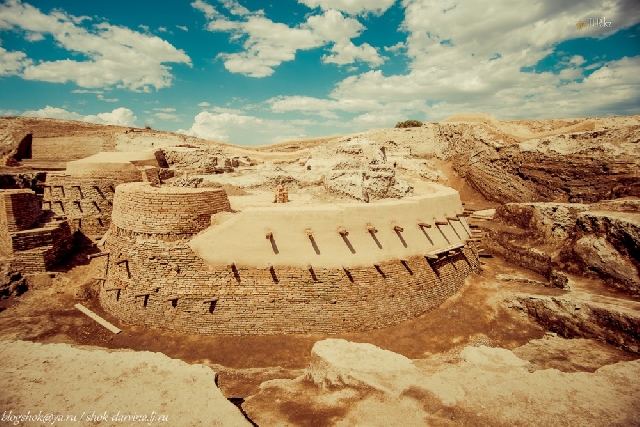
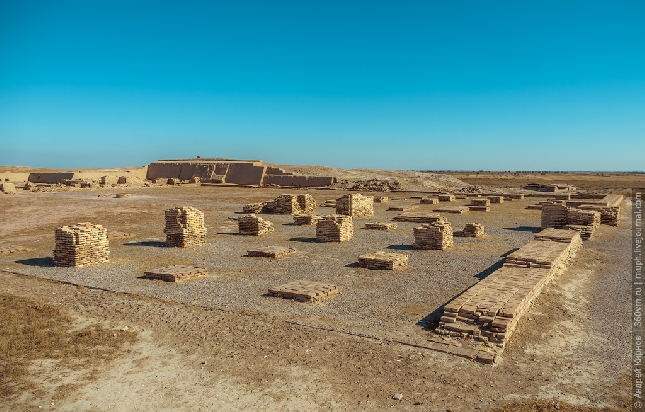
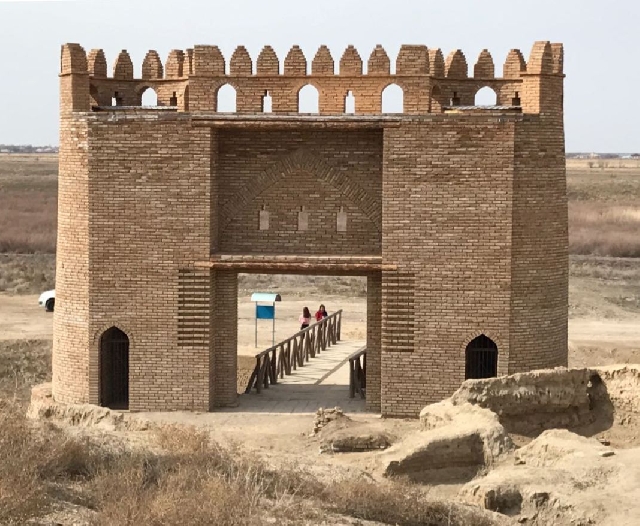
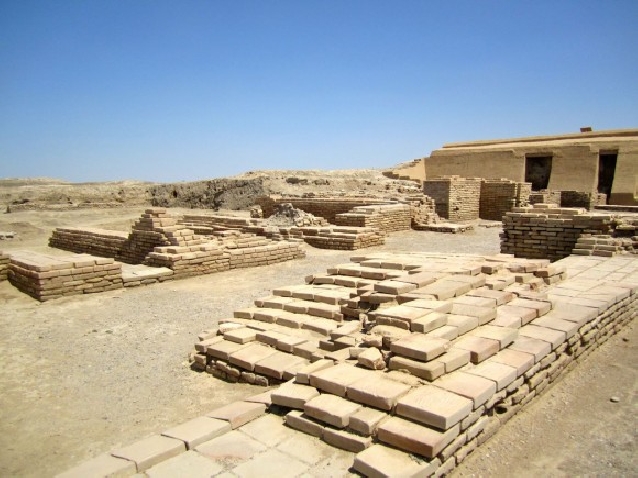
The oasis of Otrar is not one single site, but rather it is a large oasis containing a series of towns and cities. Each hill formed in the place of ancient settlements has, at present its own name: Altyntobe, Dzhalpak-tobe, Kuyuk-Mardan-tobe and Pchakchi-tobe. In earlier times, they had different names that are now forgotten and only the names of the three towns known in manuscript sources may be identified at the present ruins.The prosperity of Otrar was interrupted by the Mongol invasion of Central Asia.
In 1218, a Mongolian trade caravan of around 450 men arrived in Otrar, including an ambassador of Genghis Khan. The governor of Otrar, Inalchuq, who was an uncle of Sultan Muhammad II of Khwarezmia accused them of being Mongolian spies and arrested them, and with the assent of Sultan Muhammed, executed the entire caravan.
Genghis Khan responded by sending a delegation of three diplomats to Sultan Muhammad, demanding Inalchuq be punished; but Muhammad responded by beheading the Muslim ambassador and shaving off the beards of his two Mongol companions, provoking Genghis Khan's into a retaliatory invasion. He besieged Otrar for five months in 1219, eventually breaching its walls and executing Inalchuq. Many of the towns in the oasis never recovered and were abandoned. However, Otrar city rose again and during the troubled years of civil wars, which followed Genghis Khan's death, the town again became an important political and economic center. By the middle of the 13th century it had returned as a large trade center on the way from the West to the East. During the second half of the 14th century Southern Kazakhstan was brought into the sphere of Timur's power. In February 1405, when Timur was visiting Otrar to gather his troops, he caught a cold and died in one of the Otrar palaces. The death of Timur led to more struggles, which resulted in Abu'l-Khayr Khan conquering several tribes and placing himself at the head of a new Uzbek Khanate. Other descendants of Genghis Khan had claims over the area, and so for most of the 16th and 17th centuries there was nonstop feuding among these various parties for power over the Kazakh steppe and the Syr Darya valley, especially between the Kazakh Khanate and Dzungar feudal lords. Even so, a degree of stability was maintained in Otrar up until the Dzungars arrived in Kazakhstan.
These followed a prolonged period of revolt, which resulted in the economic decline of the area and its towns. As the Eurasian arm of the Silk Road gradually lost its importance, so did the city. Through the 17th and 18th centuries, the irrigation system slowly fell out of use, and the lower part of the Temir-aryk dried out.
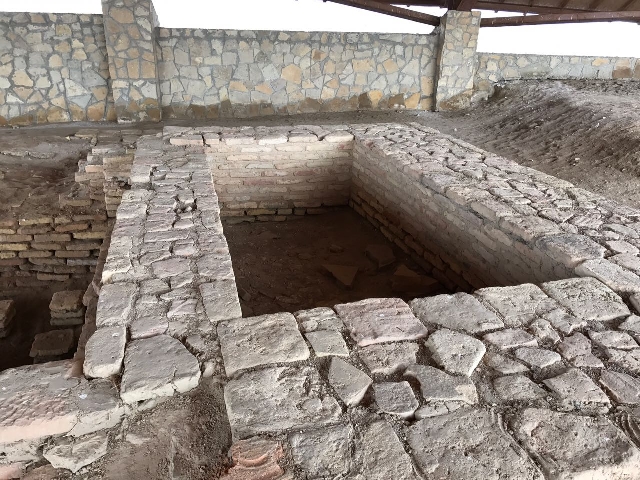
By the end of the 18th century there were only 40 families remaining in Otrar, compared to perhaps 5,000–7,000 in the 14th through 17th centuries, and the irrigated area had declined to about 5 square kilometres. The area of the settlement is about 2 square kilometres. The lowest layers of the settlement are dated from the 1st century AD and the earliest monuments are dated from the 12th to 15th centuries. Otrar was a typical fortress for Central Asia. The Ark (central fortress) and Shahristan (fortified city) formed a five-corner hill about 18 meters of height. The area of the hill is 200,000 square metres. Excavations proved that it was an advanced town with monumental buildings. The town was densely populated: the houses stood close to each and formed the group of quarters or blocks. Two bath houses, dated by 9th to the 12th centuries, were found on the rabat (suburbs) outside the city wall. The baths had central halls for bathing and massaging, rooms for undressing, restrooms and a prayer room. They had hot water supply systems. Dishes excavated near two furnaces help prove that Otrar was the center of ceramic production in Central Asia. The ceramics had elements of decoration. One of the greatest artifacts was the figure of water carrier – a camel with a woman's head and cradle on its back.
автор: русский гид Исмаил Омаралиев
написать гиду

 ваше сообщение отправлено